

This will be an important year for the climate transition. Before we begin looking at 2024 trends, let’s recap key climate indicators for a record-smashing 2023.
Two data releases this week reinforce the big lesson from 2023: The impact and cost of climate change is becoming hard to ignore.
The U.S. government confirmed Monday that 2023 was a historic year for climate-related disasters, with 28 separate events that caused $1 billion or more in losses., a meaningful increase from the previous record of 22, according to a report from NOAA. The 2023 disasters led to losses of $92.9 billion, with the largest financial losses tied to the heat wave and drought across the Midwest and South in the spring and summer. This chart shows the gap between 2023 and previous years:
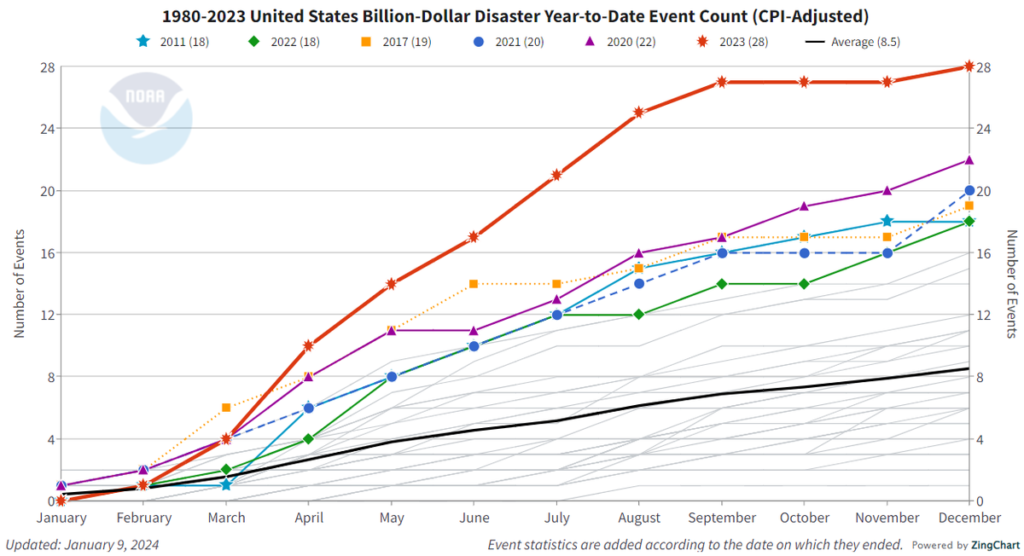
The biggest change was seen in high-impact rain events, a trend we wrote about in November (Thunderstorms Are Changing Climate Risk). There were 17 disasters related to “rain bomb” thunderstorms or hail damage.
Many Americans are acutely aware of that trend this week. This morning much of the East Coast is recovering from a major rainstorm that has caused flooding, downed trees and closed roads. Here in New Jersey we had about 3 inches of rain overnight, with 60 mph winds. Another large rain event is expected later this week across the area.
On Tuesday, the EU’s climate service confirmed that 2023 was the hottest year ever, with an average temperature 1.48 degrees C above pre-industrial levels, bumping up against the 1.5 C temperature target set by the Paris Agreement in 2015. The data from the Copernicus Climate Service documents the substantial jump from previous years:
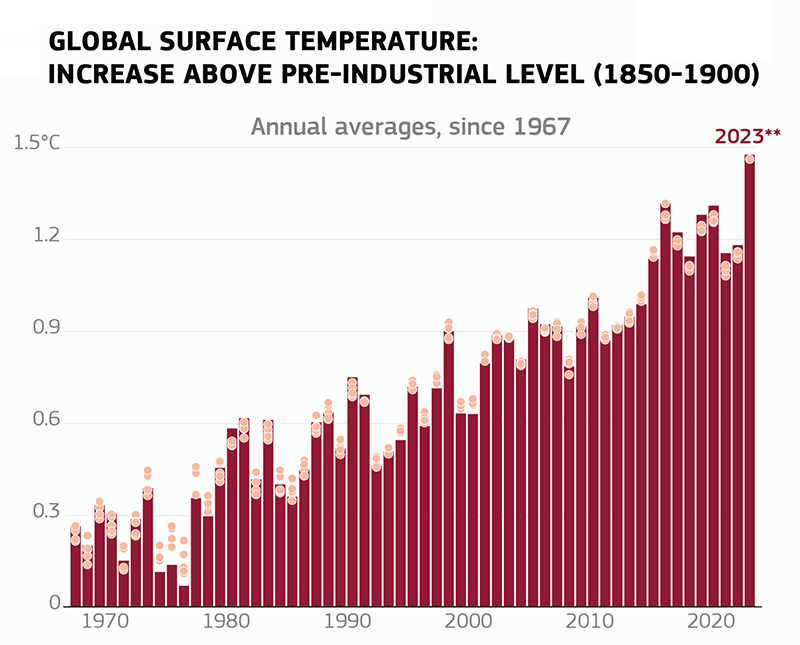
Scientists at Copernicus say it is likely that the 1.5C mark will be passed for the first time in the next 12 months. The service tied the “exceptionally high” temperatures to climate emissions.
The atmospheric concentrations of carbon dioxide and methane continued to increase and reached record levels in 2023, reaching 419 ppm and 1902 ppb respectively. Carbon dioxide concentrations in 2023 were 2.4 ppm higher than in 2022 and methane concentrations increased by 11 ppb.
“The extremes we have observed over the last few months provide a dramatic testimony of how far we now are from the climate in which our civilization developed,” said Carlo Buontempo, Director of the Copernicus Climate Change Service. “This has profound consequences for the Paris Agreement and all human endeavors. If we want to successfully manage our climate risk portfolio, we need to urgently decarbonize our economy whilst using climate data and knowledge to prepare for the future.”
As real-world warming pushes the Paris goal, 2024 will be a year to set aside assumptions about a 1.5C world and reckon with a climate transition of 2C or beyond.
You can follow Climate Pivot on Facebook, LinkedIn, Threads and Mastodon.