
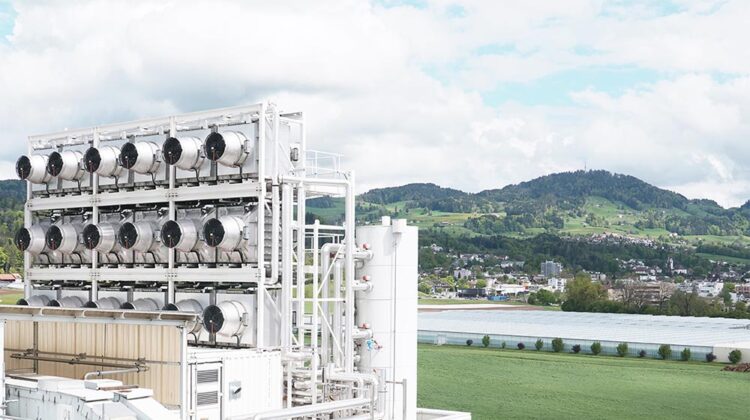
The U.S. can remove 1 billion metric tons of carbon dioxide per year using carbon dioxide removal (CDR) strategies by 2050, delivering on a key component of America’s goal to reach net-zero emissions. The kicker: It will cost roughly $130 billion annually. The report evaluates the state of carbon dioxide removal (CDR) and costs for projects in all 3,143 counties in the U.S., offering the most detailed roadmap to date for local, regional and national CDR strategies.
Roads to Removal “shows us that we can prevail in our quest to reverse climate pollution,” said LLNL scientist Jennifer Pett-Ridge, the report’s lead author.
But it won’t be easy. To achieve its net-zero goals, the United States “must use all removal methods available – oceans, forests, cropland soils, biomass and minerals and chemicals through direct air capture – to make it happen,” said Jennifer Wilcox, principal deputy assistant secretary for Fossil Energy and Carbon Management at DOE.
The Future of Carbon Removal
Carbon removal is nascent and expensive to scale. But since progress on carbon mitigation is falling behind the aspirations of the Paris Agreement, scientists now see a more important role for carbon dioxide removal (CDR), which encompasses a range of strategies to remove carbon dioxide from the air and store it underground. Carbon removal is nascent, expensive and controversial, particularly among some climate activists, who see carbon removal technologies as an enabler of continued emissions by energy companies.
“CDR is not a substitute for deep and sustained emissions reductions,” notes the 10 New Insights on Climate Science report released at COP28. “However, almost all scenarios that limit warming to 1.5°C or 2°C rely on large-scale deployment of these CDR methods.”
The report also includes a helpful chart of the many types of CDR strategies, including their market readiness and sequestration potential.
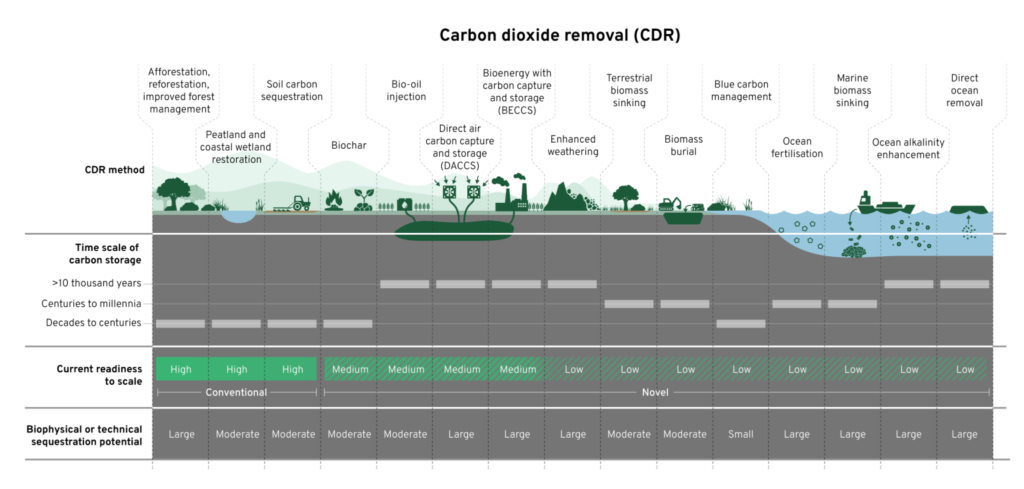
The state of carbon dioxide removal is worrisome to some climate activists, who see carbon removal technologies as an enabler of continued emissions by energy companies. Those are genuine concerns.
How to proceed? I like the balanced take from Kate Gordon of the UC Berkeley Haas School of Business, a former Senior Advisor to Energy Secretary Jennifer Granholm.
There’s no question that carbon removal is a necessary piece of this country’s path not only to meet our climate goals in the future, but to address the fires and floods bringing communities and governments to their knees today. The Roads to Removal findings confirm that taking carbon out of the air and meeting those goals isn’t just a theory, it’s a reality.
We absolutely still need to dramatically ramp up clean energy sources like solar, wind, EVs, hydrogen, and geothermal, which will reduce emissions while also helping us move away from our economic dependence on volatile fossil fuels. But we know from this report that counties across the U.S. also have the potential to drive significant reduction of the carbon that’s already in our atmosphere.
It’s time to unite as a country to deploy the full mix of solutions we need to keep communities, workers, and businesses safe from escalating climate harm.”
The report outlines the tension between regions and technologies, and the need to consider social and economic justice in developing programs. The upside: a balanced ensemble of carbon dioxide removal strategies could create 440,000 long-term jobs.
See a detailed overview from the Livermore Labs team, and a 5-minute video summary.