

There’s a bazillion headlines this week about the COP28 climate conference. Looking beyond the buzz and controversy, here are some useful tools and climate data science for the business sector that emerged from the first week of the event.
Climate TRACE Update
As COP28 opened, Climate TRACE announced an update to its emissions tracking database that massively expands the utility of its carbon and methane reporting.
TRACE is short for Tracking Real-Time Atmospheric Carbon Emissions. The online platform harnesses AI to analyze data from more than 300 satellites and 11,000 sensors around the world. Over the past year, the dataset has been expanded from 80,000 to 352 million assets, providing a more detailed view of greenhouse gas emissions and where they originate. The data is free to use and available via a map view or downloadable datasets.
“By harnessing the power of AI and machine learning paired with the right data from satellites and beyond, our models are giving us a picture of the world like we’ve never seen before,” said Gavin McCormick, executive director of WattTime and co-founding member of Climate TRACE. “And it’s allowing us to start making climate progress in a way some never believed possible.”
One of the goals of Climate TRACE is to provide major corporations with better data to drive their decarbonization efforts. Current users include GM, Tesla and Boeing, who are working with Climate TRACE to make their supply chains more sustainable.
Assessing the climate impact of vast supply chains is a huge challenge, complicated by the difficulty of getting actionable data from suppliers. By offering a third-party view of emission sources, Climate TRACE hopes to accelerate supply chain accountability, which is essential to progress on reporting of Scope 3 emissions.
“Leaders from the public and private sectors can now do what’s never been possible before,” said Al Gore, former US Vice President and Climate TRACE co-founder. “They can look clearly at the causes of the climate crisis all the way down to the individual source. They can pinpoint where to take action almost immediately.”
The 1.5C Target and Carbon Removal
A coalition of climate data science groups released 10 New Insights in Climate Science, which concluded that we are on track to rapidly exceed the Paris Agreement’s goal to hold global temperature rise below 1.5C. l
“Continuing to emit GHGs at the current rate will use up our carbon budget for 1.5°C warming in the next six to seven years,” says the report, released at COP28. “Current policies, if fully implemented, take global temperatures well above 2°C by the end of this century.”
This is not a surprise to anyone who’s been watching the headlines. But the report warns that the current course leads to “irreversible changes” in the climate.
“There is considerable risk that a long period above 1.5°C could trigger self-perpetuating feedbacks, destabilizing the Greenland or West Antarctic ice sheets, which would result in their almost complete and irreversible loss over multiple millennia and several meters of sea-level rise,” is its sobering analysis.
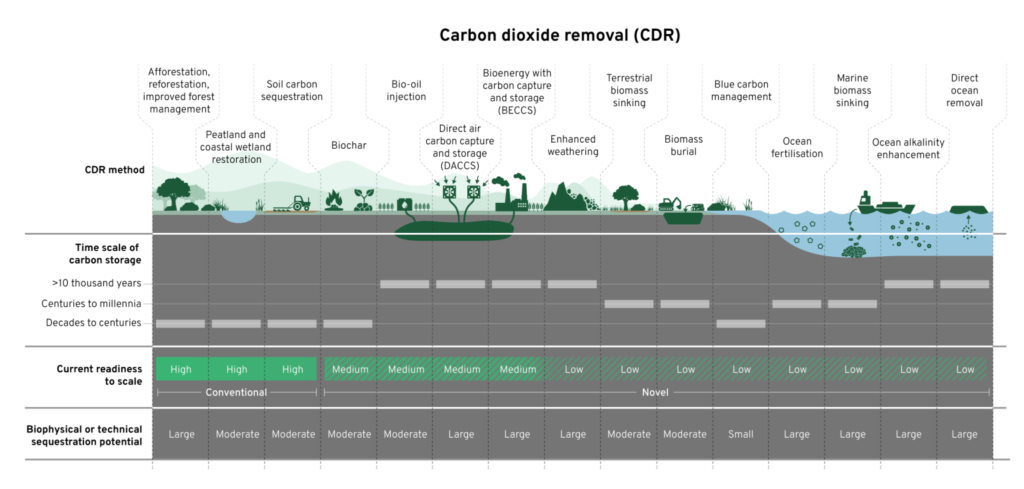
That’s one reason that scientists now see a more important role for carbon dioxide removal (CDR), which encompasses a range of strategies to remove carbon dioxide from the air and store it underground. Carbon removal is nascent, expensive and controversial, particularly among some climate activists, who see carbon removal technologies as an enabler of continued emissions by energy companies.
“CDR is not a substitute for deep and sustained emissions reductions,” the report notes. “However, almost all scenarios that limit warming to 1.5°C or 2°C rely on large-scale deployment of these CDR methods.”
The climate data science report also includes a helpful chart of the many types of CDR strategies, including their market readiness and sequestration potential.
The Future of Climate Finance
Folks working on the front lines of climate change see a larger role for the finance sector. But what do finance pros think of the opportunities in climate?
At COP28, Boston Consulting Group and The Rockefeller Foundation released a report titled What Investors Attitudes Reveal About the Future of Climate Finance. They surveyed 100 leaders in climate finance, seeking the “practitioner’s perspective” on the road ahead.
The result? Investors say funding flows for the climate transition are poised to grow over the next two years, especially in Latin America and Asia.
There are also signs of a growing focus on the climate adaptation funding gap. The top three investment themes included:
- Water quality and/or supply
- Food security
- Industrial resilience
“This suggests that adaptation and resilience is no longer just a developing economy story, and that safeguarding critical assets and enabling supply chain resilience are universal needs,” the report notes.
Those attitudes were reflected in a series of new pledges of climate finance support from host UAE and other countries.
Thanks for reading Climate Pivot! You can now follow us on Facebook, LinkedIn, Threads and Mastodon.