

Climate adaptation has a long way to go in the U.S., the government says in a new report, the National Climate Assessment 2023. As states and cities conduct assessments and develop plans, a key question is whether adaptation projects will be ambitious enough.
The release of the Fifth National Climate Assessment on Nov. 14 helps build on last week’s overview of adaptation and resilience (The Climate Adaptation Gap). It includes a detailed look at the progress on adaptation and how much work lies ahead.
First, some context: The National Climate Assessment is the U.S. government’s preeminent report on climate change, and provides the scientific foundation for decision-making across the country.
The report offered a sober assessment indeed:
Even if greenhouse gas emissions fall substantially, the impacts of climate change will continue to intensify over the next decade, and all US regions are already experiencing increasingly harmful impacts. Although a few US regions or sectors may experience limited or short-term benefits from climate change, adverse impacts already far outweigh any positive effects and will increasingly eclipse benefits with additional warming.”
There has been lots of coverage of the report’s broad conclusions. But let’s narrow our lens and focus on adaptation.
The Big Picture
The National Climate Assessment 2023 aligns with the findings of the UN Environment Program (which we featured last week) in citing a disconnect between what’s needed, what’s happening, and what’s being funded.
“Despite an increase in adaptation actions across the country, current adaptation efforts and investments are insufficient to reduce today’s climate-related risks and keep pace with future changes in the climate,” the report says. “Accelerating current efforts and implementing new ones that involve more fundamental shifts in systems and practices can help address current risks and prepare for future impacts.
About 40 percent of states have assessed their climate risk, and 18 states have climate adaptation plans, and another six states have plans underway. California has reported the most activity on adaptation.
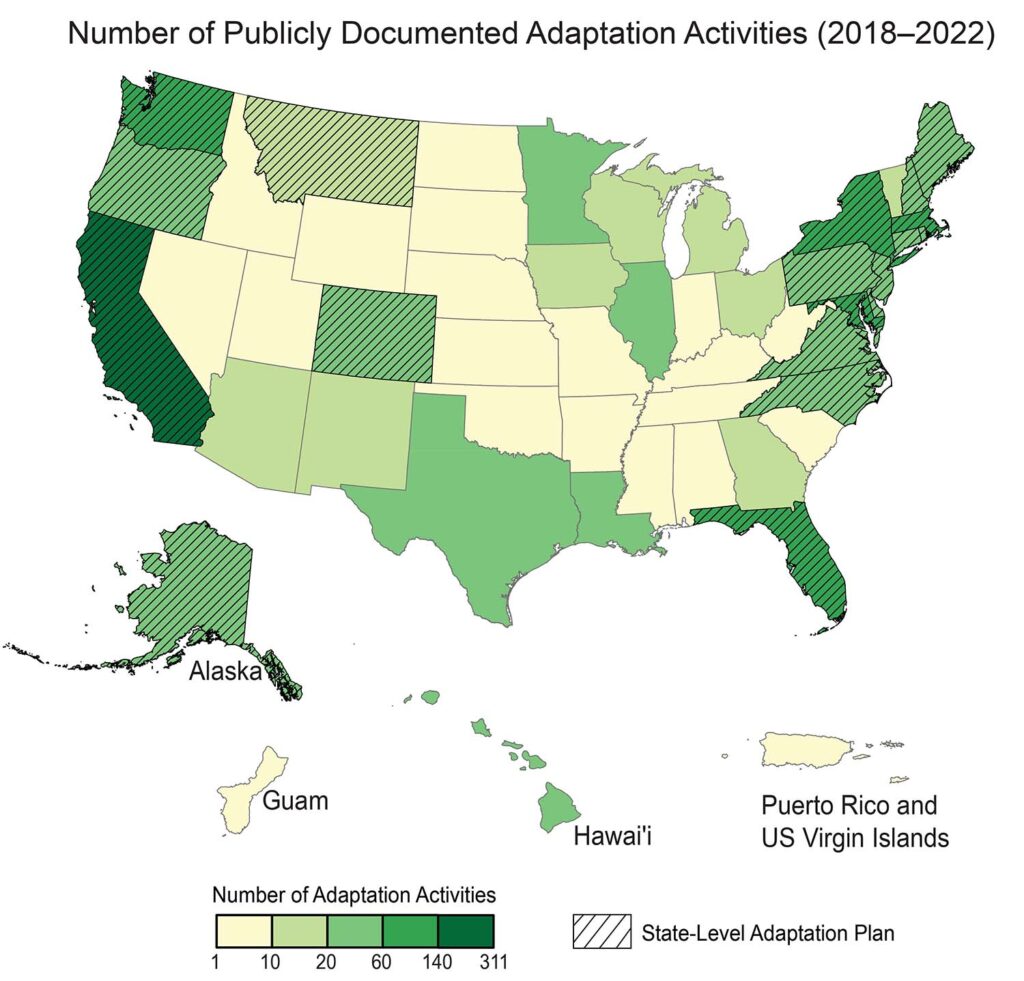
The actions underway cover a broad range. They include:
- Implementing nature-based solutions – such as restoring coastal wetlands or oyster reefs – to reduce shoreline erosion.
- Upgrading stormwater infrastructure to account for heavier rainfall.
- Applying innovative agricultural practices to manage increasing drought risk.
- Assessing climate risks to roads and public transit.
- Managing vegetation to reduce wildfire risk.
- Developing urban heat plans to reduce health risks from extreme heat.
- Planning relocation from high-risk coastal areas.
A key finding: Climate change will be increasingly bad for state and local economies, with the potential to disrupt entire industries and bust budgets for both local governments and businesses.
“Climate change threatens vital infrastructure that moves people and goods, powers homes and businesses, and delivers public services. Risks to energy, water, healthcare, transportation, telecommunications, and waste management systems will continue to rise with further climate change, with many infrastructure systems at risk of failing. Many infrastructure systems across the country are at the end of their intended useful life and are not designed to cope with additional stress from climate change.”
The Opportunities
As we noted last week, climate adaptation is not just a challenge for the public sector, but also a huge business opportunity for the private sector – and the National Assessment reinforces this.
“Mitigation and adaptation actions present economic opportunities,” the report says. “Public and private measures—such as climate financial risk disclosures, carbon offset credit markets, and investments in green bonds—can avoid economic losses and improve property values, resilience, and equity.”
The report specifically noted positive movement in the finance sector in funding adaptation and resilience projects.
Private entities have historically lacked incentives to invest in adaptation, but this may be changing: Emerging evidence points to increased investor, insurer, and credit rating agency attention to climate risk and the associated financial impacts or cost of capital for borrowers vulnerable to climate risk. More publicly traded companies are estimating and disclosing the financial impacts of climate change and the investments made to reduce climate-related risks and to maximize the opportunities. These evolutions may cause a shift in perspective by private investors if investment returns are perceived to be at risk from climate change.
Perhaps the biggest challenge in the adaptation effort, according to the assessment, is helping decision makers think bigger.
While adaptation planning and implementation has advanced in the US, most adaptation actions to date have been incremental and small in scale,” the report says. “In many cases, more transformative adaptation will be necessary to adequately address the risks of current and future climate change.”
- Incremental adaptation is described as “minor shifts in usual practices that affect small geographic areas and that have been limited in their ability to affect multiple sectors or hazards.”
- Transformative adaptation means “actions that involve persistent, novel, in-depth changes that shift the fundamental traits of institutions, behaviors, values, or technologies across multiple scales and sectors.”
We’ll be hearing more about this in the future. In the meantime, you can check out the Adaptation Chapter of the National Assessment for more details.
Resources
Links
- Climate Adaptation Needs A Rebrand: When you say adaptation, most people think “sea walls,” writes Alex Laplaza, a climate tech investor and advisor at Lowercarbon Capital. “The collective movement and energy behind adaptive climate solutions has, to-date, been somewhat uninspiring,” he writes. But Laplaza is pumped about the investing opportunity and outlines the innovations and strategies that merit investors’ attention.
- In a week like this, climate reading may feel like doomscrolling. That’s why I like Talking Climate with Katharine Hayhoe, a newsletter which strikes a balance between urgency and optimism. Hayhoe, a climate scientist and communicator, offers great tips for better conversations while explaining and “depolarizing” climate change.
Tools:
- The U.S. Climate Resources Toolkit provides an array of resources for folks interested in protecting vulnerable assets. There are case studies, as well as a “Steps to Resilience” framework for engaged stakeholders to enhance their resilience to climate-related impacts.